 REBIS
Freedom of Thought, Freedom to Communicate
Freedom is not limited to our ability to think for ourselves. It also concerns our ability to exchange with others without having to give up our privacy.
Today, our communications largely go through private platforms that centralize exchanges, collect data and set their own rules of use. At the same time, initiatives aimed at tightening control over communications and digital identity are multiplying.
The question deserves to be asked: can we still speak of freedom when our exchanges depend entirely on intermediaries who can monitor them, restrict them or deny us access to them?
Preserving our freedom to communicate
Protecting your privacy does not mean having something to hide. It simply means preserving a space in which everyone can think, talk, share ideas and maintain relationships without feeling constantly watched.
This freedom requires being able to choose our means of communication, to understand how they work and not to depend exclusively on a few large centralized platforms.
The point is not to reject technology, but to make it serve our autonomy rather than our dependence.
FreeSpeech Messenger: a free and private messaging app
It is with this in mind that I developed FreeSpeech Messenger, a free, open-source messaging app designed to protect the privacy of conversations.
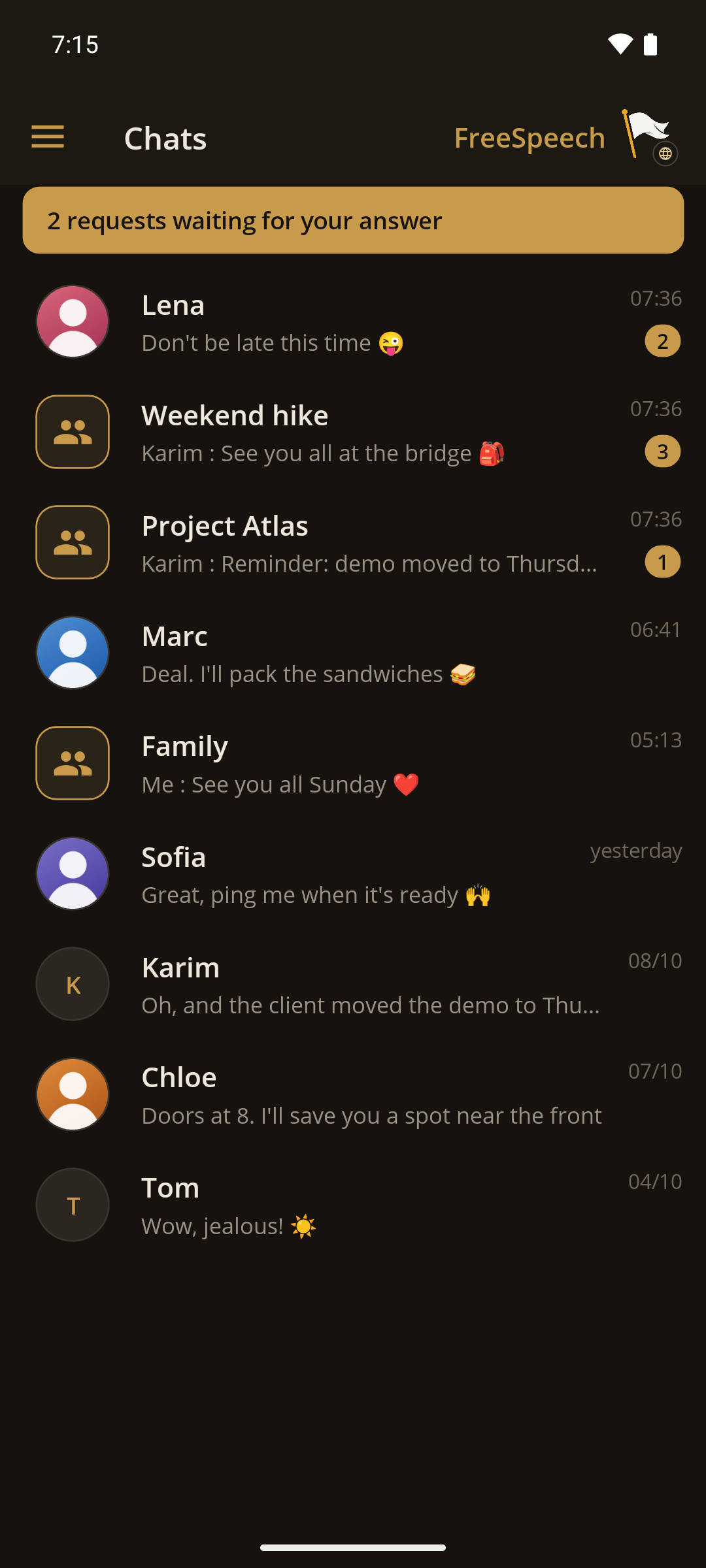
Messages are encrypted before they are sent. The relay servers carry the encrypted data without having access to the content of the conversations. The app requires neither a phone number nor an email address to create an identity.
Its decentralized architecture also allows users to be spread across several independent relay servers, without imposing a single central intermediary.
The project is under active development and available for public testing on Android.
Freedom also begins with our choices
Inner freedom and the freedom to communicate are two complementary dimensions of our autonomy.
The first invites us to understand our own mechanisms, to step back from our reactions and to regain the ability to choose. The second allows us to preserve a space for exchange in which this freedom can be expressed.
We do not control every development in society, but we can choose the tools we use and the principles we want to contribute to.
Preserving our freedom also begins with these choices.